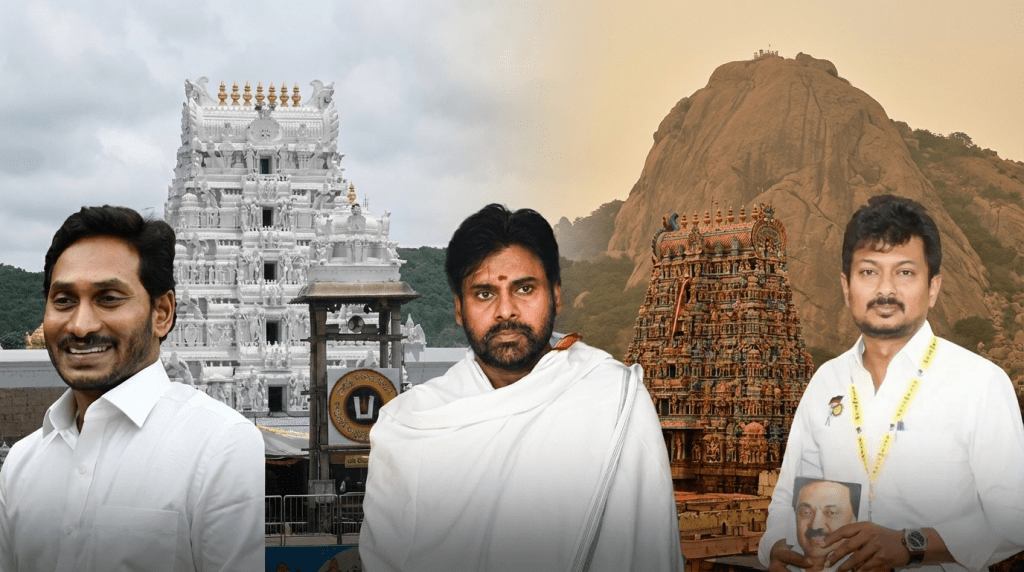
When Anand Ranganathan articulated those words, he wasn’t exaggerating. He was diagnosing. For generations, Hindus have watched their faith, culture, and institutions slowly eroded under the guise of secular fairness. And when every other space feels compromised, the only solace left lies in faith, in the quiet sanctum of a temple, under the gaze of Lord Venkateswara himself. Yet even there, the pseudo-secular rot has crept in, corroding the very institutions meant to protect the sacred.
The Special Investigation Team’s confirmation of adulteration in the sacred Tirumala laddu, the prasadam that embodies purity and devotion, strikes at the last bastion of trust. After years of being questioned, mocked, and sidelined, if even the offering to the deity stands tainted, where is the Hindu supposed to seek solace now, in a nation that once left its own Kashmiri Pandits with no refuge at all?
The Origin and the Events: A Concise Timeline
The storm erupted when the Chief Minister of Andhra Pradesh alleged that the ghee used during the previous YSRCP regime had been adulterated. The charge sent shockwaves across the state. Within days, conflicting documents, official denials, and mounting political pressure pushed the issue into the national spotlight, leading to the constitution of a CBI-monitored SIT to probe the allegations.
What the investigation uncovered was far graver than a single lapse. After a nearly 15-month-long probe, the SIT’s chargesheet named 36 accused, including the personal assistant to former TTD chairman Y. V. Subba Reddy. Investigators found that adulterated ghee was systematically supplied to TTD between 2019 and 2024. Officials estimate that nearly 68 lakh kilograms of fake ghee entered the temple’s supply chain during this period, involving transactions worth approximately ₹250 crore, exposing years of procurement failures and possible internal complicity.
But beyond the corruption itself, the scandal reopened a deeper, uncomfortable question. How do individuals repeatedly accused of being linked to another faith keep ending up at the helm of Hinduism’s holiest institutions? Under the YSRCP regime, successive TTD chairmen Bhumana Karunakar Reddy and Y. V. Subba Reddy faced persistent allegations of association with Christianity; under the earlier TDP government, Vangalapudi Anitha was nominated to the TTD board amid similar claims, revealing a pattern that cuts across party lines.
Three different leaders, two rival parties, one unchanged reality. People whose religious identity is openly questioned by devotees continue to oversee one of Hinduism’s holiest institutions. Why is a Hindu temple the only place where the devotee’s faith matters less than the political convenience of those in power?
A Wound That’s Far Older Than This Scandal
With innumerable attacks on temples, deities, traditions, and even the very vocabulary of Hindu culture, Hinduism today feels like it is being bled by a thousand cuts. The adulteration of the sacred offering of Lord Venkateswara, the Kaliyuga Daiva revered by millions, might appear to be the pinnacle of this ongoing assault. But history tells a harsher truth.
For centuries, invaders targeted Hindu temples because they understood that temples were India’s civilizational heart, centres of economy, learning, culture, and community life. The invasions eventually stopped, but the erosion did not. In modern India, it merely shifted from physical destruction to legal dismantling.
Laws Became the New Weapons
The Hindu Religious and Charitable Endowments Act of 1951 handed unprecedented control of Hindu temples to the state, authority never imposed on any other religion. When the Madras High Court struck down its worst provisions, the 1959 Congress government simply reintroduced the same powers. Other states followed with similar statutes, placing only Hindu temples, and no other religious institutions, under direct government control.
Across India, the Pattern Is Unmistakable
Kerala
The communist-led administration controls 3,058 temples through Devaswom Boards, with temple revenues subjected to an “administrative fee”, effectively a tax, ranging from 5% to 21%.
Tamil Nadu
The state controls 2.44 crore sq. ft. of temple land that should earn nearly ₹6,000 crore annually, yet generates barely ₹58 crore, less than 1% of its potential. More than 11,999 temples are so starved of funds that they cannot afford even a single daily pooja.
But the problem in Tamil Nadu goes beyond neglect. It has increasingly turned into active resistance against Hindu ritual practice itself. At Thiruparankundram, the first of the Arupadaiveedu, the six abodes of Lord Murugan, a devotee’s petition led the Madras High Court, on 1 December 2025, to direct that the traditional Deepathoon lamp be lit, reviving a long-held practice, even after which the Waqf Board continued to claim that the Deepathoon pillar itself belonged to the dargah, placing the court’s directive in contention. The state administration opposed the order on the grounds of “communal unrest”, effectively arguing that Hindus could be attacked for a simple act of devotion on their own land.
Andhra Pradesh
Tirumala’s hundi collections exceed ₹1,700 crore annually, and its assets span 7,123 acres valued at over ₹85,000 crore. Yet until a recent High Court directive, even temples earning under ₹5 lakh were compelled to surrender a contribution to the Endowments Department. And when this burden was finally lifted, the then YSRCP government swiftly moved to expand the Dharmika Parishad, granting deeper control over boards, leases, and appointments.
In essence, what invaders once attempted with swords, modern India achieved with legislation. Hindu temples were removed from devotees and handed to governments.
From Wounds to Solutions: Reclaiming Temple Autonomy
Given this long history of intrusion and dilution, it is no surprise that a growing movement now demands that Hindu temples be freed from state control and restored to the guardianship of the devotees who sustain them. The anger is not merely emotional. It stems from a simple truth. The sacred cannot be safeguarded by those indifferent, or hostile, to its sanctity.
While one end of the political spectrum openly rejects the very idea of temple autonomy, with the Deputy Chief Minister of Tamil Nadu, Udhayanidhi Stalin, going so far as to liken Sanatana Dharma to a “disease” that must be eradicated, most political responses to temple reform elsewhere have largely remained rhetorical or evasive. Against this backdrop, one of the more interesting articulations to emerge in recent discourse has come from the Deputy Chief Minister of Andhra Pradesh, Pawan Kalyan. His Varahi Declaration surfaced in the wake of the Tirumala scandal as a call to safeguard temple traditions.
The declaration speaks of a Sanatana Dharma Raksha Board, envisioned as a broader framework to protect temples, rituals, and the dharmic economic ecosystem surrounding them. Yet, within this larger vision, one proposal has drawn particular attention for its immediacy and practicality: the Sanatana Dharma Raksha Certificate, a mechanism designed to ensure that what reaches the sanctum is worthy of it.
The Sanatana Dharma Raksha Certificate
While its detailed framework has not been publicly spelt out, the underlying intent is unmistakable and may well be the need of the hour. It seeks to create a dharmic standard ensuring that every ritual material used in temple worship, not just offerings, is audited and certified free from adulteration before it reaches the sanctum.
To some, this may sound excessive. But if one community can have a worldwide Halal certification system, a mechanism that monopolizes industries, dictates supply chains, and effectively excludes other communities by economically sidelining them, then why is it unreasonable for Hindus to expect a standard that protects the purity of materials offered to their own deities?
A Sanatana Dharma Raksha Certificate would:
- Guarantee purity and ritual compliance
- Prevent adulteration like the Tirumala scandal
- Build a dharmic economic ecosystem supporting Hindu farmers, producers, and suppliers
- Reconnect temple offerings with the communities that historically sustained them
This is not just about cultural protection. It is about restoring the socio-economic dignity of Hindu communities that have been steadily displaced from the temple ecosystem they once sustained.
The Uncomfortable Question
Is there even a single political party in India today, ideology aside, that is truly willing to relinquish control of Hindu temples and return them to devotees?
The Waqf Board states its position unambiguously. “Once Waqf, always Waqf.” Waqf properties remain permanently under community control, protected by law and immune from state takeover. If one community can exercise such perpetual autonomy over every inch of land it administers, is it really too much for Hindus to seek the same for their sacred temples?
And when even this question appears unreasonable, we are inevitably led to Anand Ranganathan’s civilizational outcry:
“If this is how a Hindu is rewarded in a Hindu Rashtra, he’d much rather be in a Muslim Rashtra, because then at least there’d be no pretence of equality; a kafir will get what he deserves.”
